





DSCR Loan Rates Hold Steady — Investor Lending Surges (May 2026)
For the week ending on May 29, 2026
Table of Content
Summary
DSCR loan rates and conventional mortgage rates barely moved this week — the 30-year fixed slipped just 2 basis points, from 6.61% to 6.59%, making this one of the quietest rate weeks of the year. Two basis points. That's it. But here's the real story: while the headline rate sat frozen, the entire structure of the investor lending market was shifting underneath it — in a way that directly affects every DSCR borrower right now.
For real estate investors in New York, New Jersey, and Connecticut — whether you own rental properties in Brooklyn, Queens, the Bronx, or multi-family buildings across the tri-state area — understanding what's driving these market shifts can mean the difference between a good rate and a great one. Nonconforming loans just hit their highest market share since before the 2008 financial crisis, and DSCR investors are the engine behind that surge.
Stay until the end — we're going to show you exactly how paying down your credit card balances before you apply can improve your credit score and lower your DSCR loan rate by 25 to 50 basis points, even when the market refuses to move.
🤔Why DSCR Loans Are Taking Over the Market
Nonconforming loans just hit their highest market share since before the 2008 financial crisis. According to Inside Mortgage Finance, nonconforming loans accounted for nearly 6% of all home loan originations in 2025 — the largest slice since the pre-crisis peak of roughly 22% back in 2007. And who's driving that surge? Real estate investors using DSCR loans.
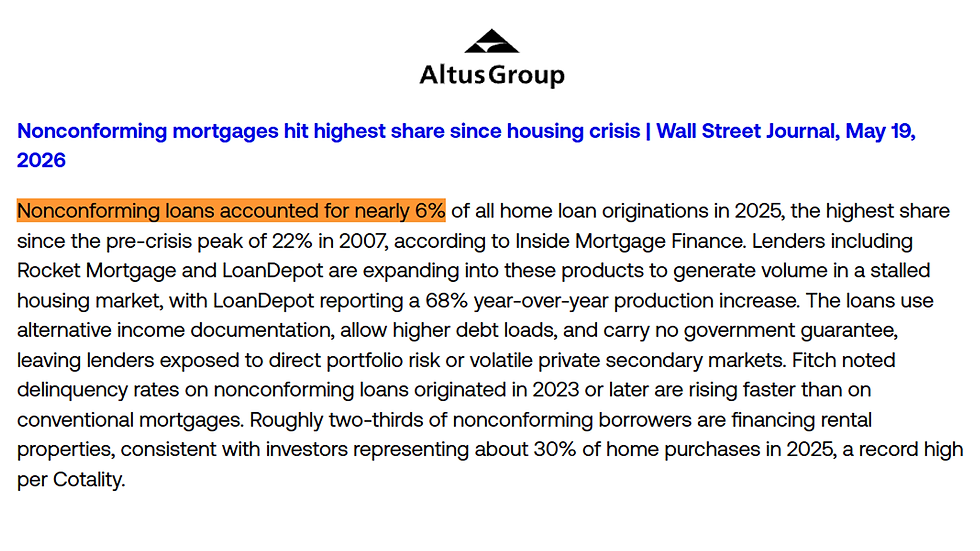
Roughly two-thirds of nonconforming borrowers are financing rental or investment properties, and investors now account for approximately 30% of all home purchase transactions. Major retail lenders have pushed aggressively into this space, reporting year-over-year non-QM production growth on the order of dozens of percentage points.
For investors across the New York metro area — from Brooklyn brownstones and Queens multi-families to New Jersey mixed-use buildings — this shift means more lenders are actively competing for your business. DSCR loans, which qualify based on the property's rental income rather than your personal W-2 or tax returns, have become the fastest-growing nonconforming product in the market. No income verification. No employment history. Just the numbers on the property.
📉What the 8.5% Drop in Mortgage Applications Means for Investors
On May 27th, the Mortgage Bankers Association reported that total mortgage applications dropped 8.5% week-over-week for the week ending May 22nd — a 9% decline on an unadjusted basis. That's a significant pullback, driven by softer purchase demand and lower refinance activity as the 30-year fixed stayed anchored in the mid-6s.

Here's the counterintuitive insight: that pain for conventional borrowers is quietly creating an advantage for DSCR investors. When agency purchase volume dries up, lenders don't just sit on their hands — they pivot. Originators are deliberately leaning into DSCR and other investor-focused nonconforming programs to keep their pipelines full.
In a market where conventional demand is contracting, DSCR investors are increasingly being treated as the preferred customer — and that competitive dynamic translates into better pricing, faster closings, and more flexible terms. If you own investment properties in Connecticut, New Jersey, or anywhere in the New York metro area, this moment is an opportunity.
💼This Week's Rate Update: Where DSCR Rates Stand Right Now
📉 30-year fixed mortgage rate: Started at 6.61% → Ended at 6.59%
That 2 basis point dip is effectively flat — well within normal daily noise. DSCR loan rates run approximately 0.75% above conventional, which puts most DSCR borrowers in the mid-to-upper 7% range this week, also essentially unchanged.

On the economic indicator front, the U.S. Department of Labor released its weekly jobless claims data in late May, and claims continued to hover near recent ranges — no sharp break, no surprise spike, nothing that dramatically altered growth or rate expectations. The labor market simply didn't give the bond market a reason to move in either direction this week.
With no new GDP estimate or revision dropping in the May 25–29 window either, markets were trading on existing expectations for moderate growth and waiting on upcoming PCE and jobs data in June. The bottom line: labor and GDP data barely touched this week's 2 basis point move. The market's focus stayed squarely on the 'higher for longer' rate environment rather than on any single economic print.
♟️The Credit Score Strategy That Can Save You 25–50 Basis Points
Now let's unpack the most actionable strategy from this week: pay down your credit card balances before you apply. Even in DSCR lending — where the property's cash flow is the primary qualifier — your credit score still directly determines which pricing tier you land in.
DSCR lenders use credit score buckets, and crossing a threshold like 720, 740, or 760 can move you into a meaningfully better pricing tier. One of the fastest ways to push your score up before the lender pulls credit is to pay down revolving credit card balances and lower your utilization rate.
Getting that utilization below 30% — or ideally below 10% — can produce a measurable score improvement in as little as one billing cycle. That score bump can translate directly into 25 to 50 basis points off your DSCR loan rate. On a $500,000 investment property, 50 basis points is thousands of dollars per year in interest savings. That's real money on every rental property you finance, whether you're doing a purchase, a cash-out refinance, or refinancing out of a hard money loan in Brooklyn, the Bronx, or anywhere across the tri-state area. walk you through exactly how to structure your deal for the best possible pricing.
Ready to Lock In Your Best DSCR Rate?
Whether you're financing a new acquisition, doing a cash-out refinance, or refinancing out of a hard money loan, the strategies and market conditions we covered this week create a real opening for investors across New York, New Jersey, and Connecticut.
📞 Call or text us directly: (718) 300-3503
We serve investors with 1–20 unit multi-family properties, mixed-use buildings, and investment properties nationwide. No income verification. No W-2 required. Just the property's numbers.
FAQ Section
Q1: Can I get a DSCR loan on a multi-family property in New York with Section 8 or CityFHEPS tenants?
Yes. DSCR loans are available for 1–20 unit multi-family and mixed-use properties, and Section 8 or CityFHEPS rental income absolutely counts toward your Debt Service Coverage Ratio calculation. In fact, government-assisted rental income is often considered more stable than market-rate rents by DSCR lenders. Properties in Brooklyn, Queens, the Bronx, and Manhattan all qualify. Call or text us at (718) 300-3503 to review your specific property.
Q2: What's the difference between a DSCR loan and a conventional investment property loan?
A conventional investment property loan requires full income verification — W-2s, tax returns, pay stubs, debt-to-income calculations. A DSCR loan qualifies based solely on the property's rental income versus its debt service. If the property's monthly rents cover the monthly mortgage payment (typically at a 1.0x–1.25x ratio), you can qualify regardless of your personal income or employment status. This makes DSCR ideal for self-employed investors, business owners, and anyone whose tax returns don't reflect their full financial picture.
Q3: How soon can I refinance a hard money loan into a DSCR loan in New Jersey or Connecticut?
Most DSCR lenders require a seasoning period of 3–12 months after acquiring or completing a property. If your hard money loan is approaching maturity or the rate is unsustainable, you may already qualify to refinance into a 30-year fixed DSCR loan. This is one of the most common transactions we handle across New York, New Jersey, and Connecticut. Contact us directly at (718) 300-3503 and we'll evaluate your timeline and options.


Comments